










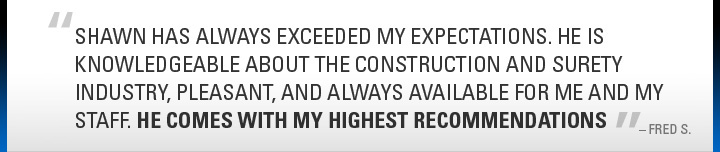

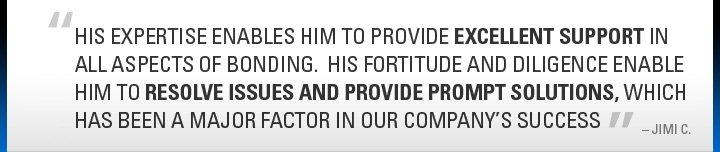
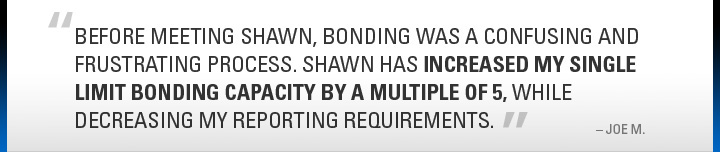





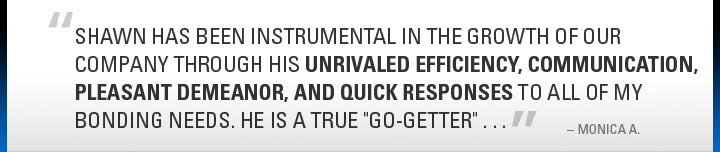







A reliable source of surety credit is vital to construction contractors and subcontractors engaged in public and private work. Contractors are increasingly being asked to post a bond as assurance that their work will be faithfully completed on time and all bills promptly paid. Contractors should use the same care in selecting a bonding agent as in choosing their bank, attorney, CPA and key managers.
What to Expect
The professional surety agent plays an important part in the underwriting process, and in maximizing the contractor’s surety credit. The following is a list of the surety agent’s normal responsibilities to the contractor:
- Assessment of a construction contractor’s qualification for surety credit.
- If the contractor is found to be unqualified, candid appraisal of what the contractor can do to meet standard qualifications.
- For a qualified contractor, assistance in selecting a surety company best suited to the needs of the particular contractor.
- Suggestions for strengthening the contractor’s qualifications, wherever possible.
- Preparation of a written analysis of the contractor’s operations, including the following: company history, organization, management, key people, type of work, track record, trade and bank credit relationships, financial performance and condition, financial trend analysis, bidding history, desired work program, business plan, future prospects and continuity plan.
- Recommendation of a line of credit.
- The making of a formal presentation to the selected surety.
- Maintaining open channels of communication between the contractor and surety, with periodic reports on the progress of open work, financial performance and business plans.
- The surety agent provides professional advice on strategies that will maintain the surety credit needed to support management’s objectives.
How to Select Your Surety Agent
A construction contractor can look for a number of things in determining whether a particular agent is a surety professional qualified to handle his/her surety needs. They are:
- An understanding of the construction industry and the construction management process, including estimating, bidding, building and cost control systems.
- An awareness of local, regional and national construction markets.
- An understanding of credit (surety credit) principles.
- Familiarity with accounting and finance, with particular emphasis on CPA accounting guidelines in construction accounting.
- An ability to analyze financial statements and work on hand schedules.
- Active involvement in construction and surety industry associations.
- Knowledge of the surety market, the surety credit process and underwriting standards.
- The respect and confidence of surety underwriters.
- Established relationships with construction oriented CPA’s, bankers and attorneys.
Construction contractors can identify most of these characteristics in a surety agent by posing a few pertinent questions. The contractor might want to have his/her financial officer, banker, CPA and attorney interview the agent for their evaluation of the agent’s knowledge of construction, accounting and credit.
The surety agent should be willing to furnish references, including names and phone numbers of existing clients.
When the surety agent’s qualifications have been established, the contractor and agent should work closely to develop the agent’s complete knowledge and understanding of the contractor’s business and his/her goals, plans and aspirations. In this, contractors must be willing to accept the agent into complete trust and confidence. Withheld information will limit the agent’s ability to service the contractor.
